 Globeskool
The skills the next decade rewards, and a report card never measures.
Ask a parent what they want for their child and you rarely hear "a better grade in geography." You hear: figure things out, handle being wrong, explain what they think, make something of their own. Those are future skills. Here are the ten Globeskool builds.
Critical thinking
Telling a good answer from a confident wrong one.
Weighing a claim, spotting a gap, and asking the question underneath the question, instead of taking the first answer at face value.
In a world of infinite content and confident machines, the child who can tell signal from noise is the one in charge.
Missions hand your child messy, real situations with no single right answer, and reward the reasoning, not a lucky guess.
Problem solving
Breaking a hard thing into moves you can make.
Taking something that looks impossible, breaking it into parts, trying an approach, and adjusting when it does not work.
Almost every job and every life worth living is one unscripted problem after another. School rarely lets kids practice that.
Every mission is a problem with stakes. Your child plans, builds, hits a wall, and works around it, which is the actual skill.
Communication
Saying what you mean so it lands.
Explaining an idea clearly, in writing and out loud, and shaping it for the person on the other end.
The best idea badly explained loses to a worse idea explained well. This is the skill that multiplies all the others.
Missions end in something your child has to present, pitch, or write up, so communication is practiced, not lectured.
Creativity
Making something that wasn't there before.
Generating ideas, combining things that do not obviously go together, and having the nerve to make the first version.
It is the one thing the machines imitate but do not originate. The kid who creates stays ahead of the kid who only consumes.
Open-ended missions ask your child to build, design, and invent, with a portfolio that proves they made it.
AI literacy
Directing AI instead of being directed by it.
Using AI as a tool with judgment: prompting it, questioning what it returns, and spotting when it is wrong.
Your child will grow up with AI either way. The difference is whether they command it or get quietly shaped by it.
AI sits inside missions your child directs, with the judgment built into the work, never a chatbot renting their attention.
Entrepreneurship
Turning an idea into something real.
Spotting a need, making a small bet, shipping a first version, and learning from what actually happens.
Initiative is the skill no algorithm grants. The child who can start things does not wait for permission to matter.
Missions push from idea to a made thing, so your child feels the loop of build, show, and improve.
Systems thinking
Seeing how the parts move the whole.
Understanding that things connect, that one change ripples, and looking for the cause behind the symptom.
The big problems of your child's life, from climate to technology, are systems. Seeing them clearly is a superpower.
Missions model real systems and let your child change a variable and watch what happens downstream.
Global awareness
Understanding a world bigger than the feed.
Curiosity about other places, people, and ways of living, and the judgment to hold more than one perspective at once.
Your child will work, trade, and live across borders that a hometown view cannot prepare them for.
Missions reach beyond the local, connecting your child's work to people and places unlike their own.
Nature and sustainability
How the living world works, and why it matters.
A real feel for how natural systems work and how human choices feed back into them.
Your child inherits the consequences of how this generation treats the planet. Understanding beats anxiety.
Missions ground the science in things your child can observe, test, and act on, not just memorize.
Tech and coding
Making the machine do what you want.
The logic of how software works, enough to build, automate, and bend tools to an idea, not just use apps.
Code is the literacy of this century. The child who can make the machine, not just tap it, holds real leverage.
Missions move your child from using tools to building with them, at a depth that fits their age band.
Practiced, not lectured.
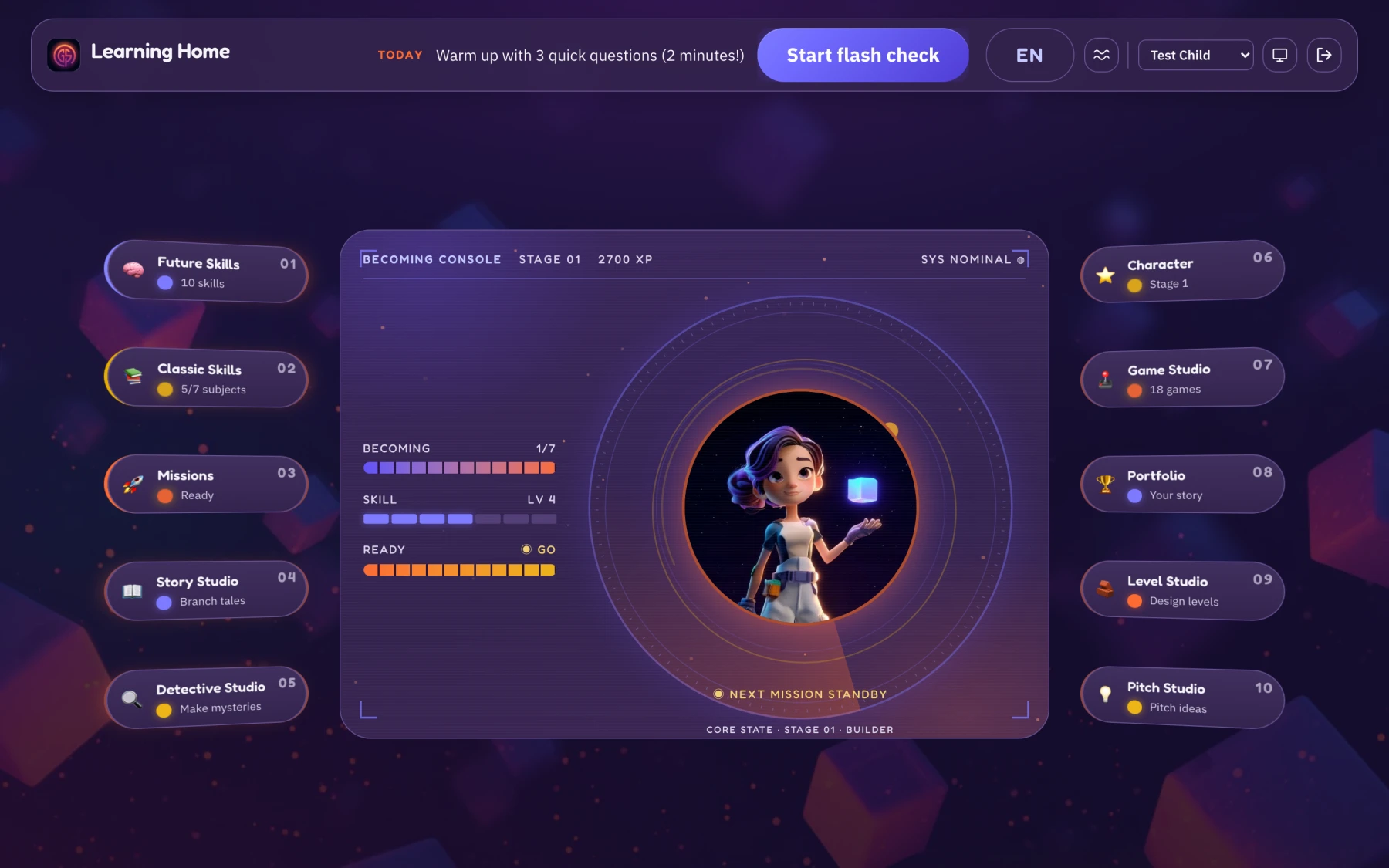
Every skill above is built inside a real mission your child finishes, and the skills they use are logged as XP toward who they are becoming.
See your child's strengths →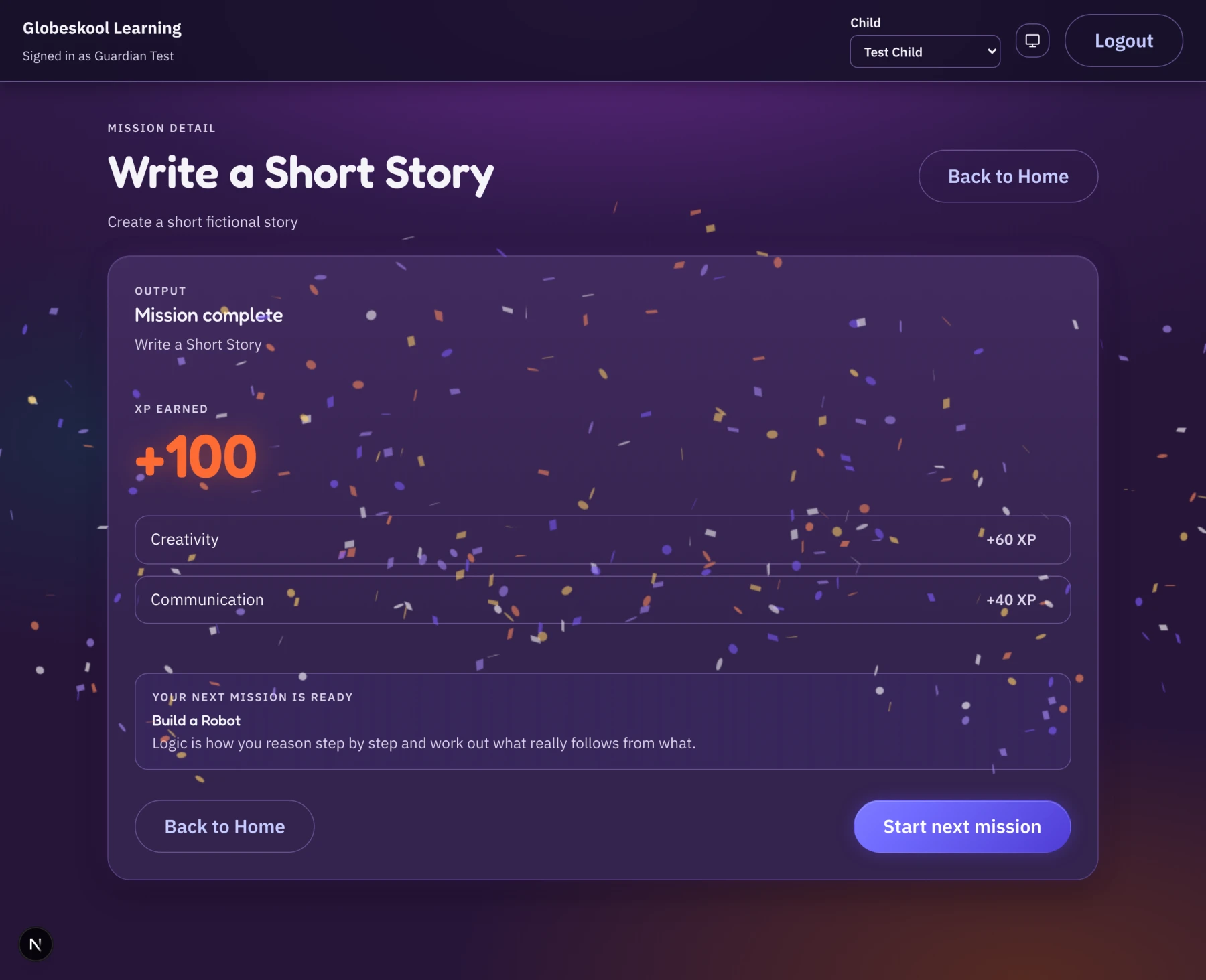
The honest answers.
What are future skills for kids?
Future skills are the abilities the next decade rewards that a report card never measures: critical thinking, problem solving, communication, creativity, AI literacy, entrepreneurship, systems thinking, global awareness, nature and sustainability, and tech and coding.
Why doesn't school teach these?
School was built to produce reliable answers on a test. Future skills show up only when a child builds something real with stakes, which most classrooms have no room for. They get left to chance.
How do you teach a skill instead of a fact?
By having the child use it. Globeskool's missions are real projects, so a skill like communication or problem solving is practiced inside the work and logged as XP, rather than lectured and forgotten.
What ages is this for?
Globeskool is built for children aged 8 to 16, with two age bands so the missions and language fit where your child actually is.
See which future skills your child is ready to build.
The free Future Skills Test maps your child's strengths across these skills and sends a personalized report, yours to keep whether or not you try Globeskool.
Not ready for the test? Hear from us the day we open.